
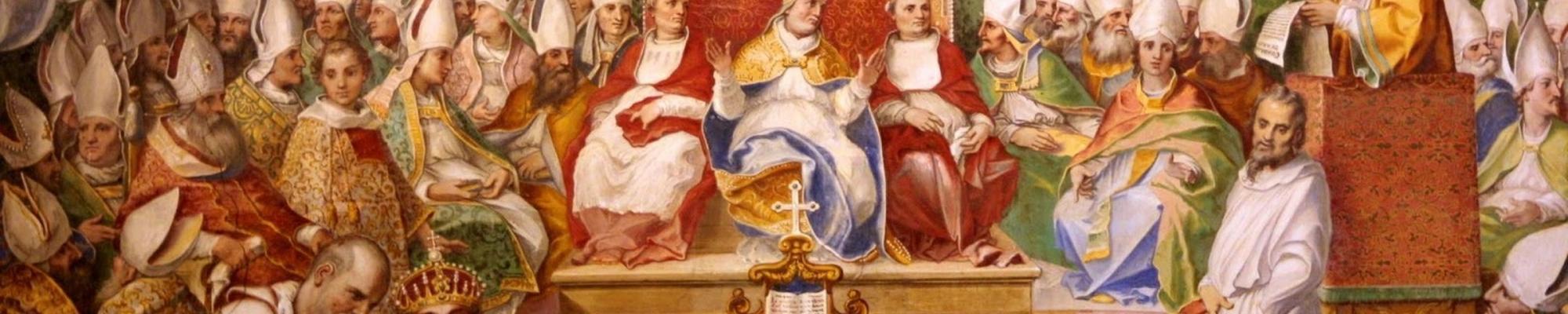
Council of Nicaea Began - May 20
The Council of Nicaea was first called on May 20, 325 - 1,700 years ago - because the early Christian Church was in turmoil over a burning question: Was Jesus fully divine, or was he an extraordinary teacher, but less than God? The question had ardent followers on both sides, and the controversy became so intense that it threatened to split the Church and even the Roman Empire. Constantine the Great, the first Roman emperor to embrace Christianity, wanted unity in his empire, so he convened the Council in the city of Nicaea, located in what is now northwestern Turkey, bringing together over 300 bishops from across the Roman Empire, and instructed them to decide once and for all the nature of Jesus.
After an intense, two-month debate, the council declared that Jesus is "of the same substance" as the Father - fully God. The decision became the cornerstone of Christian doctrine and continues to this day. They also composed the Nicene Creed, a statement of belief, which Christians still recite today - affirming Jesus as “God from God, Light from Light, true God from true God.”
Spiritual Reflection
While the Council of Nicaea affirmed the divinity of Jesus Christ, New Thought invites us to consider what divinity reveals about ourselves. We do not deny Jesus' divinity. We celebrate it. But we see it as a mirror, not a pedestal. Jesus is not the great exception, but the great example of what it means to awaken to the Divine within.
The early church, wrestling with chaos and controversy, reached for clarity and unity. In New Thought, we embrace unity too - but a unity that includes, not excludes. We affirm what Jesus himself said, “The kingdom of God is within you.” His divinity is not a wall. It’s a window into our own spiritual potential.
The kingdom of God is not in some far-off realm, hidden behind clouds or locked behind doctrine. The kingdom of God is within you. It pulses in your breath, your being, your awareness. Jesus came not to set himself apart, but to call us inward - to awaken us to what has always been true. He reminded us of our divine inheritance: “Is it not written in your Law, ‘You are gods’?” The light that was in him is in you. “You are the light of the world,” he said, as a call to radiance.
And if you believe in this way of being, Jesus said, “You will do the works that I do, and greater works than these.” Not because you are trying to become divine, but because you already are. The Spirit seeks expression through you, just as it did through him.
Your calling is not to remain small or separate. “Be perfect, therefore, as your heavenly Father is perfect.” Not someday. Not in another life. But now, in every thought, every act of love, every spark of truth that you let shine. You are not here to worship the light in someone else. You are here to be it.
WANT TO EXPLORE MORE?
"The Hidden Gospel: Decoding the Spiritual Message of the Aramaic Jesus"
Neil Douglas-Klotz
Faith tradition: Christianity
The Nicene Creed solved the question of whether Jesus was human or divine with obscure words, describing Jesus as "begotten, not made, being of one substance with the Father." The creed also established some version of what is called the Trinity -- a belief in God as Father, Son, and Holy Spirit -- as an orthodox doctrine of the Western Christian church. However, a large number, perhaps even a majority, of Christians at the time believed that God is one and indivisible, as the Jewish scriptures taught and as the name for God, Alaha (which means Unity), clearly states in Jesus' own tongue, Aramaic... The council at Nicaea banned all versions and variations of the Gospels except Matthew, Mark, Luke, and John
The Nicene Creed was born in a moment of genuine spiritual urgency, but it was also deeply political. Emperor Constantine, seeking unity in a fractured empire, called the Council of Nicaea to deliver a single, enforceable orthodoxy. That moment marked a turning point. "Right belief" became the standard for belonging - and eventually, for survival. Over the centuries, that shift opened the door to excommunications and heresy trials against mystics, reformers, and visionaries; to crusades and holy wars, often waged not just against outsiders, but against fellow Christians; to colonial missions that baptized violence in the name of salvation; and to deep-seated patterns of anti-Semitism, misogyny, homophobia, and systemic racism - all justified by distorted interpretations of Christian doctrine. When faith becomes a gatekeeper instead of a guide, religion turns into a weapon. The Nicene Creed, which begins so beautifully with “We believe in one God,” has too often been used to say, “We 
The Council of Nicaea was first called on May 20, 325 - 1,700 years ago this week - because the early Christian Church was in turmoil over a burning question: Was Jesus fully divine, or was he an extraordinary teacher, but less than God? The question had ardent followers on both sides, and it was threatening to split the church right down the middle. Enter Emperor Constantine, who wanted unity in his empire, so he convened the Council in the city of Nicaea, bringing together over 300 bishops from across the Christian world, and instructed them to decide once and for all the nature of Jesus.
After an intense, two-month debate, the council declared that Jesus is "of the same substance" as the Father - fully God. The decision became the cornerstone of Christian doctrine and continues to this day. They also composed the Nicene Creed, a statement of belief, which Christians still recite today - affirming Jesus as “God from God, Light from Light, true God from true God.”
Spiritual
The Nicene Creed (traditional text):
We believe in one God, the Father Almighty, Maker of heaven and earth, of all things visible and invisible. And in one Lord Jesus Christ, the only-begotten Son of God, begotten of the Father before all worlds, Light of Light, very God of very God, begotten, not made, being of one substance with the Father, by whom all things were made. Who for us and for our salvation came down from heaven, and was incarnate by the Holy Spirit of the Virgin Mary, and was made man; and was crucified also for us under Pontius Pilate; He suffered and was buried; and the third day He rose again, according to the Scriptures; and ascended into heaven, and sits at the right hand of the Father; and He shall come again with glory to judge the living and the dead; whose kingdom shall have no end. And we believe in the Holy Spirit, the Lord and Giver of Life, who proceeds from the Father [and the Son], who with the Father and the Son together is worshipped and glorified, who
The Nicene Creed was born in a moment of genuine spiritual urgency, but also profound political strategy. Emperor Constantine sought unity in his empire, and the Council of Nicaea provided a single, enforceable orthodoxy. That set a pattern: right belief became the standard for belonging—and eventually, for survival. Over time, that creed, though meant to unify, became a dividing line. It ushered in an era where theological disagreement was met not with dialogue, but with condemnation. It led to:
*Excommunications and heresy trials, often targeting mystics and visionaries,
*Crusades and religious wars, not just against non-Christians, but other Christians,
*Colonial conquests, where the cross was wielded alongside the sword,
*And centuries of patriarchy, anti-Semitism, homophobia, and othering—all cloaked in doctrinal “rightness.”
The chaos produced wasn’t just historical - it was spiritual. When faith becomes a gatekeeper rather than a guide, religion turns into a weapon. The Nicene Creed, which begins with “We believe in one God…”, too often became a declaration of, “We are right - and you are not welcome.”
In New Thought, we honor the mystical heart beneath the doctrine - the divine impulse that seeks connection, not control. Where the Nicene Creed drew lines around who belongs, we draw circles that include all beings as expressions of the One.
We don’t reject the historical creed outright - we reclaim the spirit behind it. “We believe in one God…” becomes a declaration of Oneness, not of orthodoxy. God is not a distant ruler but the indwelling Presence in every soul, every tradition, every act of love. Christ is not confined to one historical figure but is the pattern of divine potential within us all - what Ernest Holmes called “the idea of God in the mind of humanity.”
New Thought invites us to move beyond belief systems that divide and toward a lived spirituality that unites. We seek not control over others’ beliefs, but freedom within our own. We affirm a faith that liberates the soul, honors diversity, and sees all paths - Christian, Jewish, Hindu, Buddhist - as potential doorways to the sacred. 